Showing posts with label Petersburg2. Show all posts

Tuesday, 15 October 2019

St Petersburg Second Day, 1 of 8 -The Peterhof Summer Estate

Well, it's our second day in St Petersburg. Yesterday was a long, hectic but very interesting day and after a good night's sleep on board the Sea Princess we are ready for new ventures today. We had an early start and boarded our coach at 7.30am because it was 90-120minute coach drive to The Peterhof Summer Estate our first visit for the day. It was expected that we'd spend at least 3 hours exploring the vast estate. This Summer Estate, built by Peter the Great in the 18th century.
It's been extended by each of the tsars following after after Peter the Great's rule and some buildings and parts of the grounds of the estate had to be rebuilt due to the damage done during its bombardment by enemy aircraft in WW11. 
All restoration works have been faithfully carried out to preserve the original appearance and layout of this magnificent estate which is a complex of palaces, gardens, mountains and waterfalls. 
The Peterhof Estate has been listed as a UNESCO UNESCO world Heritage site and it is easy to see why this status has been given. It is one of Russia's most famous tourist attractions with over 1 million visitors every year.

The architecture of the Palaces and the beautiful gardens very closely resemble those we'd seen on our visit to Versailles, in France. Originally, in 1709, when work began on the estate, Peter the Great built Monplaisir Palace. It's design was based on a Dutch style and he intended it to be his summer retreat where he could relax after the harsh winters of the city.
However, inspired by his visit to the French Royal Court in 1717,  Peter the Great commissioned his architects to continue extending the buildings on the estate, in the sumptuous and majestic Baroque style so fashionable in Russia and Europe at the time. He also commissioned two French garden designers and landscapers who had  been responsible for establishing Louis XIV's  extensive gardens surrounding the Palace of Versailles and his aim was to 'out-do' Louis'fabulously exotic palace  in Versailles.
The massive park and forest area which forms much of the estate has been divided into two parts. The Upper gardens which are more formal with impressive fountains and a water garden and the Lower gardens which has a collection of pools , fountains, small mountains, fruit trees and a forest. I'll refer to more about the  gardens later in this blog.

 We arrived early at the estate and it appeared that we were the first there because from  where we'd left the coach we had an excellent view of the estate. Stretch before us were magnificent formal gardens with wide avenues of red crushed-stone pathways beckoning us to enter. Best of all there was not a tourist in sight so we had the garden to ourselves and we able to take some beautiful photographs without hoards of tourists blocking our view. 
A series of ponds with statue-fountains (not yet spraying) stretched ahead of us and in the distance a long pink palace building formed a backdrop to the garden. This was indeed a complex stretch of palace buildings connected together and enhanced by a golden pagoda at each end. 
We walked  towards the palace buildings, enjoying the crisp early morning air and stopped to take a closer look at the bronze fountain statues. The craftsmanship was superb, the design and figures 'spoke' of power, success and pride.

Arriving at the palace entrance doors we were staggered to find that already hundreds of people were lined up in long queues, awaiting entrance into the palace buildings. We had left at 7:30 am and expected that at least we will be in the first group to enter the palace but alas we had to wait at least 40 minutes before we were able to enter but boy it was worth waiting for! Behind us streams of new tourist groups started arriving every minute that we were waiting to get inside and were grateful that we had made the effort to leave early because their wait was going to be a lot longer than ours. Such is the popularity of the Peterhof Estate. 

The Grand Palace is extremely grand and lavish from the entrance hall through every other room and there are many. The Entrance hall reminded us a little of the Entrance Hall into The Hermitage, in St Petersburg, except that we think that the Entrance hall in the Peterhof Estate use of gold flourishes on the walls and ceiling borders is much more extensive and intense. We climbed the Ceremonial dual Staircase which is made of white marble and is flanked by a series of superbly crafted gold statues standing on pedestals. These steps led us directly into an even more glittering-gold encrusted room, the Ballroom. Its huge glass windows, chandeliers and mirrors reflected light onto all the gold encrusted furnishings and wall decorations and the whole Ballroom became a dazzling shimmering array of glitter. It all seemed "a  little over the top" if you ask me! But that's what the baroque architectural style and decor demands and it does outshine Versailles by a tad. 
It was all very hard to take in, for whereever we looked there was glittering gold. The gold wall embellishments stretched up the walls and around the ceiling borders which surrounded a wonderful ceiling painting of maidens dancing in the clouds - a mind boggling sight! Again, as in The Winter Palace (now home of the Hermitage) the  parquet flooring patterns throughout the Peterhof palace are exquisite and unbelievably well crafted by artisans whose skills have been lost to our generation, l'm sure. 

Every room we entered in the palace, was lavishly decorated from the furnishings to the gold of the mirrors, the furniture, the flooring and even down the the detail of the ornaments in the rooms. Everything was incredibly ostentatious. I will name some of the rooms that are included in the blog, if I can remember them:

The Blue and Gold Morning Room with a dainty coffee sit on the coffee table. - 


The Breakfast Room was incredible! Its gilded furniture and heavily decorated doors framed in a heavy gold embellishment oozed extravagent wealth.  In contrast the simple table cloth with its floral decorations was gentle and easy on the eye. As was the exquisite porcelain dinner settings and the soft warm hues of the parquet flooring gave the room warmth. Take time to study this room because we did and there is so much to see.
But there's more!

St Petersburg Second Day, 2 of 8 -The Peterhof Summer Estate

Many of the rooms in the palace were filled with tourists and we often had to wait for the crowded rooms to 'thin out' before  we could have a good look at all that each room had to offer. The wait was well worth it because every room delivered something new and wonderful to see.


The Portrait Hall's walls are covered from with 368 female portraits by Pietro Rotari. The individual canvas portraits are separated by narrow gilded frames and the  mosaic effect is very striking. Rotari has manage to capture his female models in poses that reveal their individual personalities. It was interesting to study some of the looks on the females' faces and to try and imagine what their occupations may have been in the mid 1800's. The Portrait Hall is also enhanced by a wooden piano and other furniture carved from rich mahogany timbers. The 3D parquet flooring makes an interesting contrast to the four sets of brilliant white doors which are decorated with elaborate gilt plant and rocaille motifs. Above each door the embellishments continue with golden sculptured female busts, surrounded by foliage and flanked by two birds also gilt in gold. Incredible craftsmanship!

The Dressing Room walls are covered with a bright blue pasley-patterned rose-motif silk wall paper. It looks very feminine and the  luxurious look is enhanced by the gilt trimmings on the timber furniture. Notice too that the chairs have been upholstered in silk material that matches the silk wallpaper, perfectly. Look closely and you will see that the rose motif theme is repeated on the vases and candle holders that decorate the room. 


In contrast, the White Dining Room is mainly pure white with tourquoise blue trimmings and white furniture which emits a peaceful and relaxing atmosphere. 
The silver table settings are elaborate, the dinner service is extensive and made from the finest porcelain with the daintiest of designs. Look at the fragile but perfect glasses, some with plate gold edgings and the huge but beautifully-fashioned table urns that decorate the table.
I would have had my heart in my mouth if I had to wash the settings or even lay the table with the amount of cutlery, glassware and crockery needed to be handled.


The Tsars wife's bedroom decorated in soft pink and blue hues with satin bed coverings is perfect for a bedroom. The bed looks sumptuous and soft and inviting but of course we couldn't try it out. Again the walls were covered in a silk  cloth which appeared to have an Asian theme with images of cows, ducks, servants and servant ladies wearing Japanese style of clothing. An odd choice but maybe it was in vogue at the time. Gold mirrors and trimmings added luxury to the room. 
  
In another bedroom setting we noticed an unusual addition in the room, for on the wall opposite the bed a curtained alcove with a silk covered settee provided a restful looking area for reading or just relaxing.

Continuing down the hallway  we passed another reception room which looked like a study. It had elaborately gold encrusted patterns on its entrance doors, beautiful damask blue wallpaper, huge windows and another central painting on the ceiling. 

Throughout our tour of the palace we often came across some unusual items of furniture in some of the rooms. Here are three that took my attention. 
The first, a sumptuously gold cabinet-clock which had obviously been acquired by one of the tsars, as a trophy item gathered when travelling through Europe. It was taller than me and very grand but it's timing wasn't correct.  Had the the timekeeper of the clock slept in, and not had time to wind-it-up today?

The second item was a very tall white porcelain object which I learned was a Dutch style round ceramic stove which was used to heat the room when the weather turned cold.  These stoves were very fashionable in the 18th century and quite efficient. When a wood fire hearth in the lowest section of the unit is lit the generated heat, heats the air in the porcelain chambers above. When the ceramic walls became hot,  heat radiates from the stoves'ceramic walls into the room. 

The third item was a round table with a gold pedestal statue of a child holding the table top. The table top was inlaid with different coloured granite samples and other coloured stones which formed a unique and colourful mosaic top. It is a beautiful piece of art work as well as a practical piece of furniture that anyone would be proud to have in their home. 
There were many other decorative objects and items of furniture that I found fascinating but I've limited myself to just three in this blog.

St Petersburg Second Day, 3 of 8 - Outdoor Garden The Peterhof Estate


Before going out into the wonderful gardens of The Peterhof Summer Estate we visited the Throne Room in the palace.  We were surprised that the Throne Room did not have an abundance of gold glittery decorations like so many other rooms that we'd visited. 
However, we were pleasantly surprised that the largest room in the palace, the Throne Room was an unpretentious but relaxing room, with both the walls and ceiling painted a pure white. The only other colour that had been added to the walls and part of the ceiling trimmings was the same tourquoise-blue that was used in the Dining Room.  Chandeliers, hanging from the ceiling provide light to lighten the Throne Room at night but most of the light that comes into the room during the day, streams through the two-tiered arched windows which line two sides of this long throne room.  Between each window tall mirrors also reflect light across the room. Royal-red velvet curtains with tassels have been gently draped around the arch of each window and this adds dignity to this large but plain room. 
At the east end of the the room the focal point is the throne. It is seated on a three step dias which is covered in rich royal-red carpet. The  modest sized throne and footstool are also covered in royal-red velvet material with gold trimmings on the legs and edges of the throne. Directly behind and above the throne stands a huge painting of Catherine II, riding her horse. 
The west end wall is covered in series of large canvas oil paintings which depict episodes from naval battles where Russia has been the victor. I have taken  A close-up photograph of one of the paintings. It is very realistic with smoke billowing from burning galley ships. In  the foreground you can just make out sailors who have managed to escape the inferno and mayhem of battle.

Next we headed for the estate gardens. We exited the palace by French doors which opened out onto a grey and white chequered patio but true to form the patio terrace was adorned with rows of green and gold urns with plant and animal motifs. Having just left the grandeur and opulence of the palace we were about to enter the grandeur of the gardens and forest ahead of us. Looking down from the patio lay a  whichformal geometrical layout of gardens, lawns, fountains and waterways which reminded us of the beautiful gardens in the grounds of Versailles in France. Some people refer to The Peterhof Estate as "The  Versailles of Russia". 
However, Peter the Great may have based his garden plans on the grand Versailles concept but he envisioned a garden of epic proportions, filled with golden fountains, water courses, marble statues and staircases and avenues of cherry, apple and lime trees never before seen in Russia.

At the foot of the patio area  is the centrepiece of the palace complex, the Grand Cascade which I will talk about later in the blog. Just below the Grand Cascade we looked down upon a man-made canal which leads out to the sea. This Sea Channel was one of the most adventurous and extensive waterworks projects carried out during the building of the palace and it is still used today to ferry goods and visitors to the Palace complex. The canal divides the garden areas but several bridges cross over the canal and provide access to all areas of the forest and lower garden areas. 

The Lower Park and garden area can be reached either by descending marble stairscases or walking down a long curved driveway. We took the curved driveway route because it look over some very pretty garden beds. When we reached the lower garden area we explored many different pathways. The garden areas were well established with a wonderful array and variety of plants. We also saw several fountains as well as a cafe, enclosed parkland areas and pavilions where many tourists sat relaxing and talking and enjoying the sunshine.  

One of the fountains had a bright bronze muscled half-man-half-fish statue wrestling with a sea monster. It was a " little over the top" for my liking but it fitted in with the baroque style of this palace complex.
The gardens were in full bloom with beautiful blossoms, wonderful perfumes and multi-coloured garden beds designed in perfect patchwork patterns. We came across tree lined pathways that led us through forest glens and rows of spruce trees which would be laden with snow in winter.  
It was such an enjoyable, relaxing and pleasant garden to explore because of the water features, the variety of trees, extremely colourful flower gardens and interesting pathways, full of surprises.


Virus-free. www.avast.com

St Petersburg Second Day, 4 of 8 - Outdoor Garden The Peterhof Estate

Even in the Lower Garden the garden designers have used the hilly landscape areas to their advantage and have created gravity driven fountains and waterfalls. 
One particularly large tiled artificial waterfall with a gravity driven waterfall really attracts the attention of tourists because it is a piece of grand artwork as well as a water feature.itself. It is named "The Dragon Waterfalls" because it has 3 water dragon sculptures which spout water over the blue and white geometrical tiles of the waterfall- slide area. The waterfall ceramic tiles area is flanked on either side by graceful, marble statues of beautiful maidens in various poses. It is so unusual and a photographers shooting spot. I didn't find it beautiful, but garish! The graceful maidens looked out of place with the gargoil-type of sculpture of the three gruesome looking dragons. maybe that's the point of the artwork, but it was lost on me.

A liitle further on we came across a very unusual set of water fountains at the edge of the forest area. The fountains have been crafted to look like small pine trees growing on a small hill mound. However, these trees are man-made and when tourists venture near them they are showered by sensor-activated water jets and taken by surprise. What a novel idea!

After spending about an hour and a half exploring the beautiful gardens below the palace we headed back up the slope towards the Grand Cascade area where there was going to be a display of waterfalls and music.
Looking up from the lower garden as we had a wonderful view of the palace with its golden onion-domes, peach coloured palace walls and baroque architecture. 
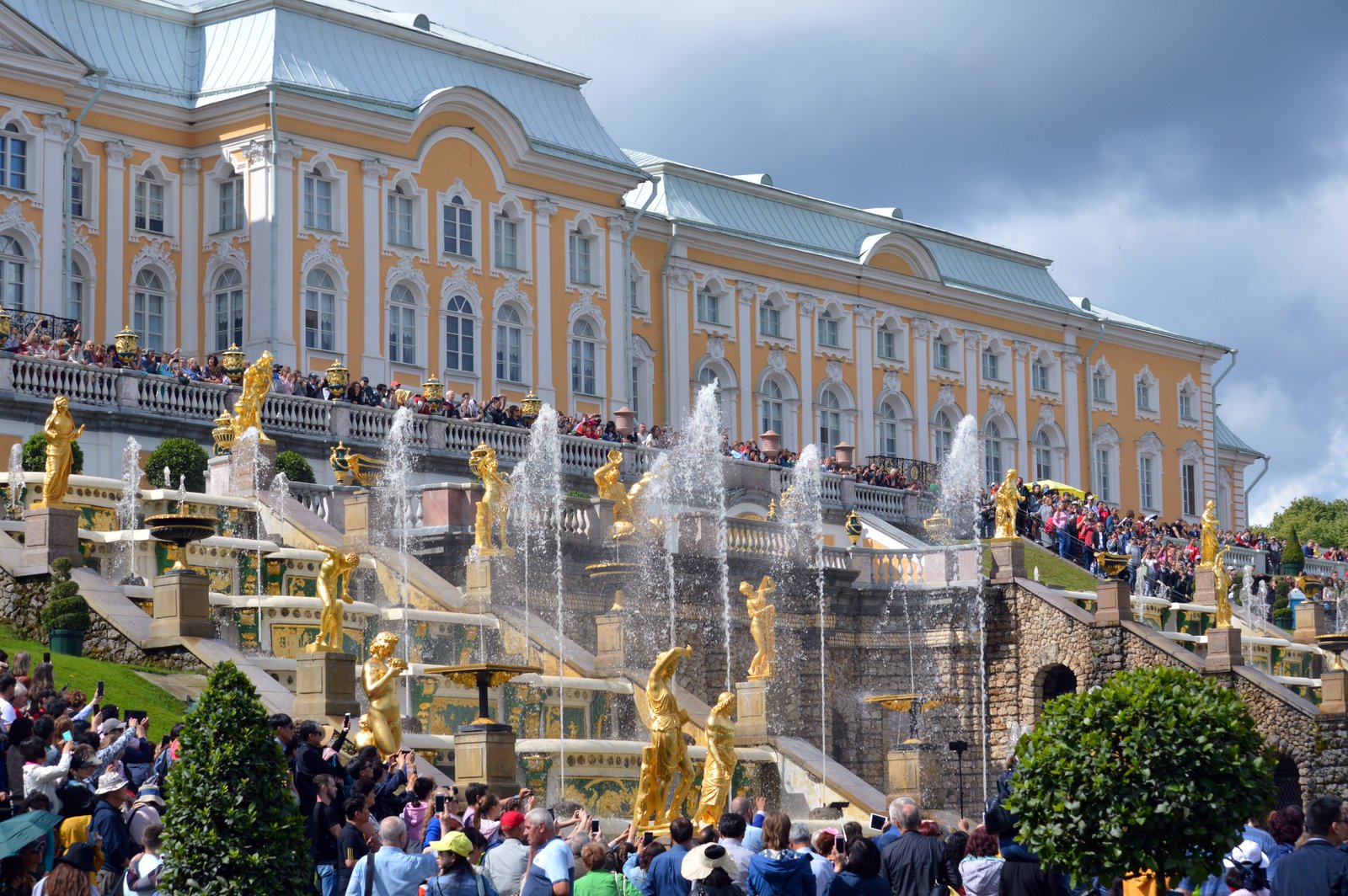
As we approached the water fountain area we were surprised to see hundreds of people lined along the balustrade of the palace, down all the marble staircases that lead down the hillside slopes and crowded across the lawn areas below the cascade fountain area. It was difficult to find a viewing spot but we squeezed beside some fellow tourists and waited for the show to begin.

The Grand Cascade is the centre piece of the formal garden. It is a spectacular sight even without the water flowing. It boasts the world's largest system of fountains having 3 cascading waterfalls, 75 fountains, 138 water jets and more than 39 gilded statues stand glistening and adorning the waterfall areas of the Grand Cascade. 
Even more surprisingly, is the fact that the waterfalls and fountains flow without the use of pumps.  Water for the fountains comes from natural springs, collected in the upper gardens and supplied by a gravity-fed water system. The  water system is 22 km long and has been designed to use the natural slope on the terrain to supply sufficient water for the fountains and cascades of the estate and to keep them functioning up to 10 hours a day. 


We stood with  hundreds of tourists waiting for the water show to begin and as we waited dark clouds began to gather in the sky. They grew blacker and blacker but they didn't break and pour down upon us. Then suddenly, the  waterfalls and fountains began to flow. They bubbled at first and then they spurted spouts of water into the air at different heights . The golden statues glistened in the sun as the water tumbled over them and it was a spectacular sight to see. Then as an added surprise, a lion sculpture started shooting a 20 metre jet of water up into the sky.
It seemed incredibly unbelievable that such a splendidly spectacular water show was taking place without the use of any pumps but such is the engineering feat of Russian garden designers who harnessed the power of natural spring waters through a system of pipes that still function as well as they did when the water project was completed in 1724. 
Everyone stayed until the end of the show, madly clicking their cameras and 'oo-ing' and ar-ing' as the water jets, fountains and waterfalls ebbed and flowed and spouted and spirted water, high into the air. when it was all over we realiused that there was no music during the show! or was there? Yes there was because the water made its own music- the sound of 75 fountains, 138 water jets and 3 waterfalls is unique.

As we left The Peterhof Estate and headed for our coach the blackened clouds lowered and threatened to swallow up the Palace buildings which stood dazzling and majestic against the black backdrop of the stormy skies. 
What another fantastic experience and special tour we had just enjoyed at The Peterhof Estate but we still had 2 more places to visit and it was now almost 2pm. We ate a packed lunch on the coach (there was no time for a leisurely lunch like the one we had yesterday) as we were driven to yet another palace - one that was to be full of more surprises.